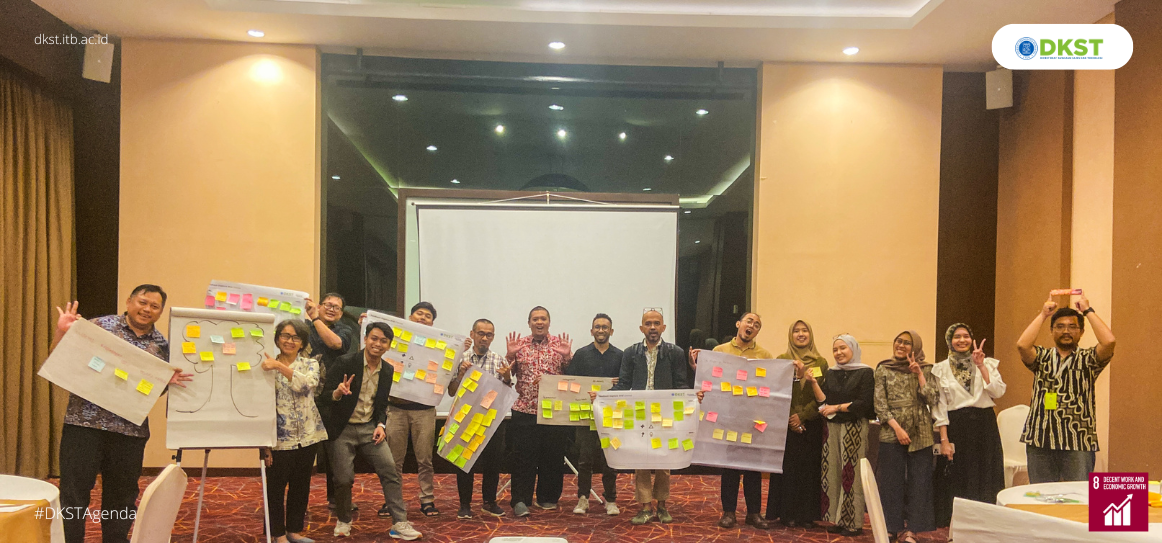
Blung, dkst.itb.ac.id- On September 12th, 2024, the Directorate of the Science and Technology Area (DKST) held a workshopDesigning Comprehensive Innovation Metricsat the Luxton Hotel, Bandung. This event is held to construct more comprehensive and relevant innovation metric, as well as the ITB's efforts in optimizing the hieroglyphic research that is aligned with the market needs. This workshop is attended by various players of interests involved in the innovation ecosystem on ITB.
One of the main topics discussed is the measurement of innovation usingTechnology Readness Level (TRL). Although TRL has been the standard metric for technology readiness, participants have revealed that this approach still has limitations. Too technical focus often ignores the aspect of commercial readiness and market diversity. Dr. Yazdi Ibrahim and Ir. Sugeng Joko Sarwono emphasizes the importance of addingBusiness Readness Level (BRL)as a more holistic support indicator. BRL will help assess the commercial potential of innovation so that innovation is not just technically ready, but can also be implemented and market.
Discussion also highlights the need to develop the metric innovation which is more emphasizing the balance between approachestechnology push- innovation driven by technology research - andmarket pull, where innovation is produced based on market needs. According to Dr. Bodhi Prihartono, the metric drafting has to be aligned with the Techno Park roadmap (STP) ITB, in order for innovation to be generated to support the hilirization strategy and to be able to make real impact.
The goal of this workshop is to construct a more relevant and adaptive metric innovation in supporting the research commercial. By combining TRL and BRL, the DKST ITB hopes to create a more comprehensive system of innovation evaluation. These newly constructed metrics will cover all kinds of important aspects, starting with technology readiness, market analysis, to potential risk and business worth.
The result of this workshop is a new framework innovation that the researchers in ITB expected to adopt. The framework provides a complete guide to evaluate innovation readiness from different dimensions, not only based on technology's sophistication, but also commercial readiness, including regulatory and sustainability aspects. For academics, these metrics will help evaluate the efficacy of technology produced before entering the commercial stage. Meanwhile, for entrepreneurs, the metric becomes a tool to assess the potential innovation in fulfilling the market needs.
The framework generated from this workshop will soon be implemented in the process of measuring innovation on ITB and STP. This new metrics is expected to be able to amplify ITB research hilirization strategies, encouraging innovation that is not only academic but also capable of providing a real solution to industry and society.
With more directional and comprehensive measurements of innovation, the ITB hopes to accelerate the process of hilirization of research and encourage innovation to be ready to compete. This framework is a strategic move for the DKST in supporting the creation of sustainable and impacting ecosystem innovation.