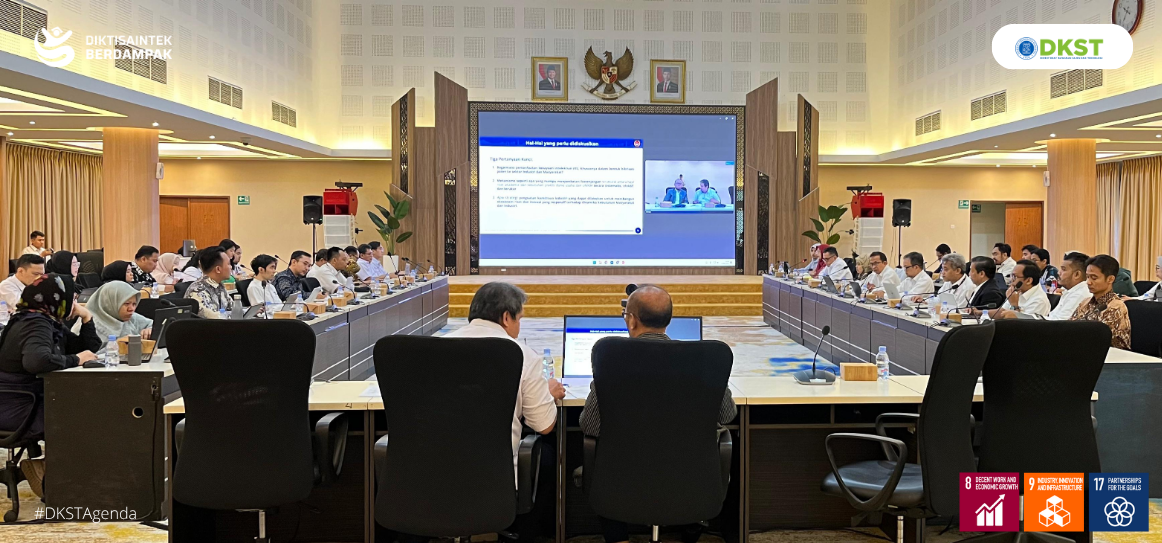
Bandung, dkst.itb.ac.id – The government continues to strengthen the national innovation ecosystem by encouraging more concrete use of research results in the industrial sector. This commitment is confirmed in Coordination Meeting for Utilization of Research and Innovation Results: Synchronization of Patent Downstreaming in Universities and Industry, which was organized by the Coordinating Ministry for Human Development and Culture (Kemenko PMK) on June 24 2025 in Jakarta.
Led by the Deputy for Coordination of Education Quality Improvement, this meeting became a strategic forum across ministries, research institutions and universities, to formulate concrete solutions to accelerate the downstreaming of patents and commercialization of local innovations.
One of the main issues that has emerged is the low level of utilization of intellectual property that has been produced by research institutions and academics. Of the 859 patents registered with the National Research and Innovation Agency (BRIN), only around 30 patents (around 3%) have been successfully licensed or commercialized. Although this figure is in line with the global average (3%-5%), the government considers that domestic innovation potential should be able to produce a much greater economic impact.
The low contribution of the industrial sector in funding and utilization of research is also in the spotlight. Currently, the private sector's contribution to research funding in Indonesia is still around 16%, lagging behind neighboring countries such as Malaysia and Thailand which have exceeded 20%.
BRIN encourages increased synergy between universities, research institutions and the business world. Proposals include developing a more attractive fiscal incentive policy and strengthening its role innovationbroker to bridge industry needs with available research results.
The micro, small and medium enterprise (MSME) sector was also identified as a group that needed support for adapting research-generated technology. The Ministry of Cooperatives and SMEs highlights the importance of preparing a road map for downstream research based on the needs of regional superior commodities. Joint production houses in 16 provinces are said to be potential assets that can be utilized for small-scale technology trials and development.
However, challenges remain, especially regarding the provision of appropriate tools, technological information that is difficult to access, and the need for an economical and budget-friendly approach for MSMEs.
LPDP and Technical Ministry support
The Education Fund Management Institute (LPDP) noted that it had allocated more than IDR 3 trillion since 2013 to fund more than 3,000 research activities, which produced more than 2,000 intellectual properties. Even so, Indonesia's ranking in the Global Research Index is still not optimal.
In response, LPDP emphasized the importance of involving industry from the research design stage through initial business assessments, as well as selecting research topics that have local characteristics but have the potential to excel in the global market.
The Ministry of Industry expressed its support through the development of a manufacturing center in Purwakarta, West Java, which is expected to become a collaboration node between universities and industry. Since 2006, the Ministry of Industry has collected more than 120 innovations, and is currently reviewing incentives such as super tax deduction for industries that adopt local research results.
The Directorate of Downstreaming and Partnerships, Ministry of Higher Education, Science and Technology also highlighted the importance of curation schemes and matching funds as a bridge between academics and business people.
College Initiatives: Many Breakthroughs, Still Need Support
Universities such as IPB, UGM, ITB, UI, and Telkom University presented various initiatives to strengthen research downstream. IPB, for example, has trained more than 500 startups based on research results, while UI implements a 70:30 incentive system in managing intellectual property for inventors.
However, academics also noted a number of obstacles, including the lack of human resources trained in downstreaming, the weakness of a standard research management system, and the lack of partnerships with international industry. Most of the research results are also not based on market demand (market-driven), making it difficult to commercialize.
To bridge these challenges, universities encourage formation technology marketplace, preparation of legal protection regulations for researchers, as well as strengthening the intermediation function which is able to "translate" academic research into business format.
Strategic Steps: Synergy and National Consortium
In his direction, the Deputy for the Coordinating Ministry for Human Development and Culture conveyed five strategic steps: (1) Preparation of supporting regulations and sustainable funding to strengthen the national research ecosystem; (2) Formation National Consortium for Downstream Research which is led by a state university with a legal entity (PTN-BH); (3) Mapping innovation potential and industrial needs based on market demand; (4) Promotion of innovation through showcases, pitching, and developing technology marketplaces; and (5) Intensive involvement of technical ministries and institutions such as BRIN, Ministry of Finance, and Bappenas in planning and implementing downstream policies.
These steps are in line with the National Medium Term Development Plan (RPJMN) 2025–2029 which makes innovation an important pillar in the knowledge-based national economic development strategy.
This coordination meeting shows the government's seriousness in combining the strength of academic research with industrial realities. Downstreaming research is no longer an option, but rather a necessity in building the nation's competitiveness.
By strengthening cross-sector synergies, adaptive regulations, and targeted policy support, the government hopes that Indonesia's intellectual property can be further optimized to support economic growth, increase technological independence, and create a real impact on society.