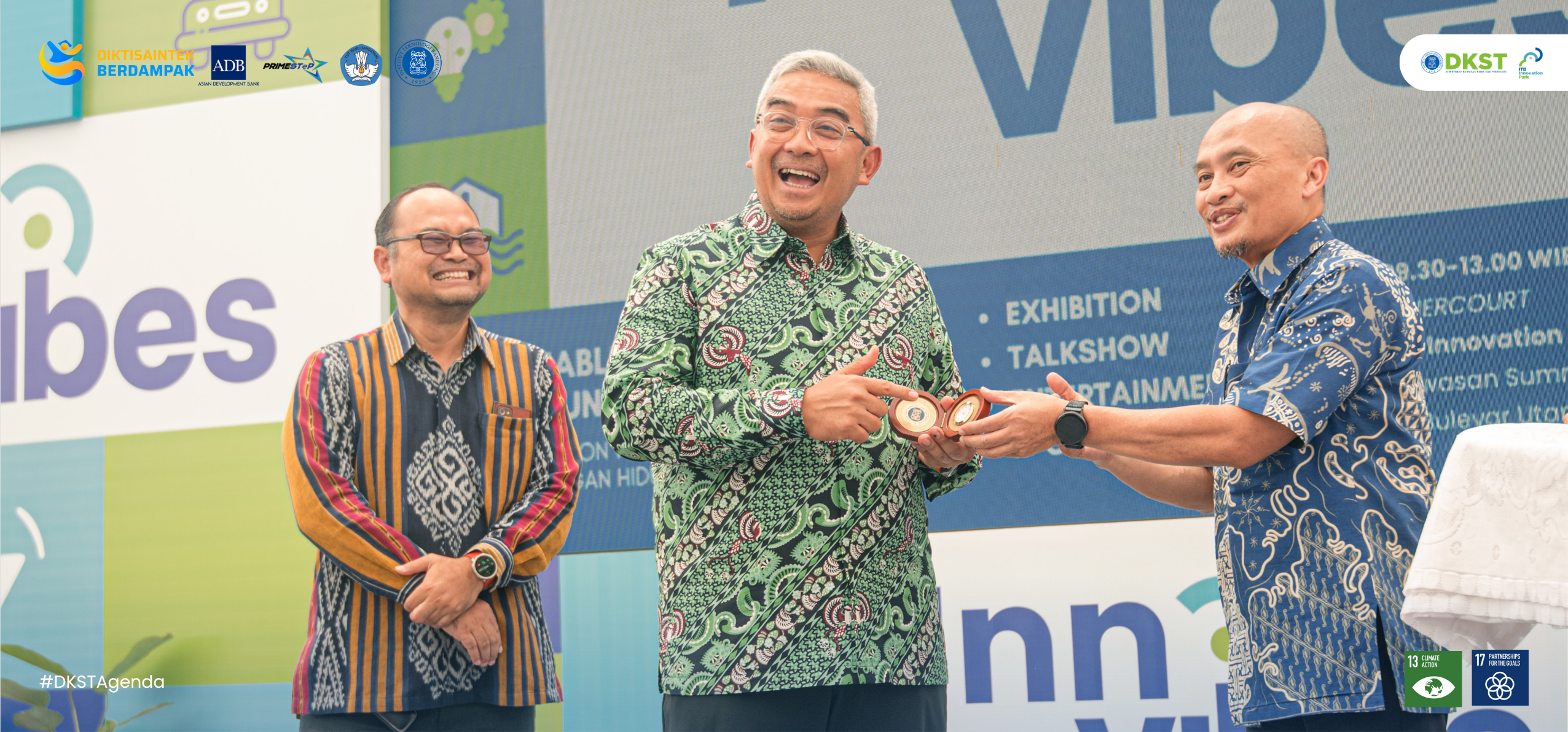
Bandung, dkst.itb.ac.id – In the midst of noisy city growth and environmental challenges, Bandung is looking to the future in a new way, through innovation. From the Summarecon area, the Bandung Institute of Technology (ITB) opened a space for cross-sector dialogue and collaboration at the INNOVIBES Vol. 3 entitled “Sustainable Infrastructure & Community Resilience". This activity is a meeting point between academic research and urban reality, between technology born in laboratories and the needs of citizens regarding waste and environmental problems.
In this city that is known for being creative, piles of rubbish are currently a reflection of the fragility of the urban system. When the landfill was full, and the streets were filled with untreated residue, Bandung residents learned an important lesson that the city's resilience is not built from concrete, but from the ability to adapt.
This awareness is the background for INNOVIBES activities this time. ITB, through the Regional Directorate of Science and Technology (DKST), is not talking about innovation in sterile rooms, but about real efforts to help Bandung find new patterns of waste management that are more resilient, sustainable and humane.
"We want ITB innovation to be present in society, to be part of the solution, not just research," said Ir. R. Sugeng Joko Sarwono, M.T., Ph.D., Director of DKST ITB. "The role of the campus is to bridge ideas with reality, so that research results do not stop at academic tables, but touch the lives of residents, especially in Bandung."
INNOVIBES is a forum for the ITB innovation ecosystem to interact with the wider community. This activity presents discussion sessions, as well as research exhibitions and the work of ITB-assisted startups that focus on sustainability.
In front of the participants, the Mayor of Bandung, Muhammad Farhan, shared his views on the need for strong collaboration between the government and campuses that involves community participation. In talk show with the theme "Bandung City Resilience in Waste Management", he highlighted how complicated the waste system in big cities is, which cannot be solved only with policy, but with social and technological innovation and community participation in its implementation.
"Our relationship with ITB, for example, as an innovation engine is quite strong, there is a lot of collaboration that we can do, the main challenge is how to encourage community participation in waste management. "This work cannot be done with a partial work approach," he said.
The discussion became a shared reflection that sustainable development is not just about physical infrastructure, but also social resilience that grows from citizen participation.
Innovation Born from Research, Tested in the Field
In this activity, a number of ITB research results were presented as concrete examples of the application of science for the public interest. One of them is MASARO (Zero Waste Management), a waste processing technology developed by the ITB research team to convert waste into energy and new materials with economic value. MASARO is now being implemented in several regions in West Java as a model for a circular economy-based waste system.
There is also Blockwood Modular House, an environmentally friendly modular construction system resulting from SAPPK ITB research which can be used for fast post-disaster buildings or dense urban housing. These two innovations are real symbols of how laboratories can produce social solutions.
"Innovation is not just technological sophistication, but the courage to answer real problems," said Joko Sarwono. "We at DKST want ITB Innovation Park to become a living laboratory where ideas are tested, implemented and improved together with the community."
Another interesting session was the Community Podcast "From Campus to Community: Innovation for Sustainable Development.” Here, researchers, startups and innovators share stories of their journey in bringing campus technology to society, where each story depicts the same vision, namely creating innovation that supports everyday life.
In his speech, Plh. ITB Chancellor, Prof. Ir. Agus Jatnika Effendi, Ph.D., emphasized that sustainability is impossible to achieve alone. “Collaboration is key. "Through INNOVIBES, we want to invite all stakeholders including government, startups, investors, academics and communities to join in a concrete green innovation movement," he said.
According to him, the existence of the ITB Innovation Park in the Summarecon area is the realization of ITB's dream of presenting research that does not stop in journals, but lives in society. "Sustainable infrastructure is about people and how technology can strengthen the social and economic resilience of citizens," he added.
Via INNOVIBES Vol. 3, ITB positions itself not only as a producer of knowledge, but also a partner in social transformation. Through DKST and its network, this campus wants to make Bandung a... living lab so that innovations are tested, implemented and developed together with society.
—
About DKST ITB
The Regional Directorate of Science and Technology (DKST) is the ITB implementation unit tasked with managing the ITB Innovation Park and facilitating technology transfer activities, applied research collaboration, and downstreaming of campus innovation products. Through various programs such as INNOVIBES, DKST is committed to making ITB a national innovation catalyst capable of bridging the academic world with the needs of industry and society.
Website: dkst.itb.ac.id/itbinnovationpark.id
Media Contact:
Cytra – DKST ITB
cytraria@itb.ac.id |+62 856 9584 3000