According to the Statistic Center (BPS), Indonesian avocado production by 2025 reached about1.07 million tons, rising from approximately 919 thousand tons in 2024. These numbers show the size of Indonesian avocado commodities, as well as the possibility of utilizing the side results that have not been utilized yet.
Indonesia also has different varieties of avocados that are cultivated in different areas. However, the economic value of avocados still mainly rests on its fruit. Her skin and seeds are generally removed after being consumed or treated.
Do you not exercise your reason.
Get to know Nanocellulosa: Small Materials with Great Potential
Nanocellulose is cellulose-based material with at least one dimension of nanometers. This material draws attention to the world because it has characteristics such as good mechanical power, high surface area, light weight, and comes from renewable resources.
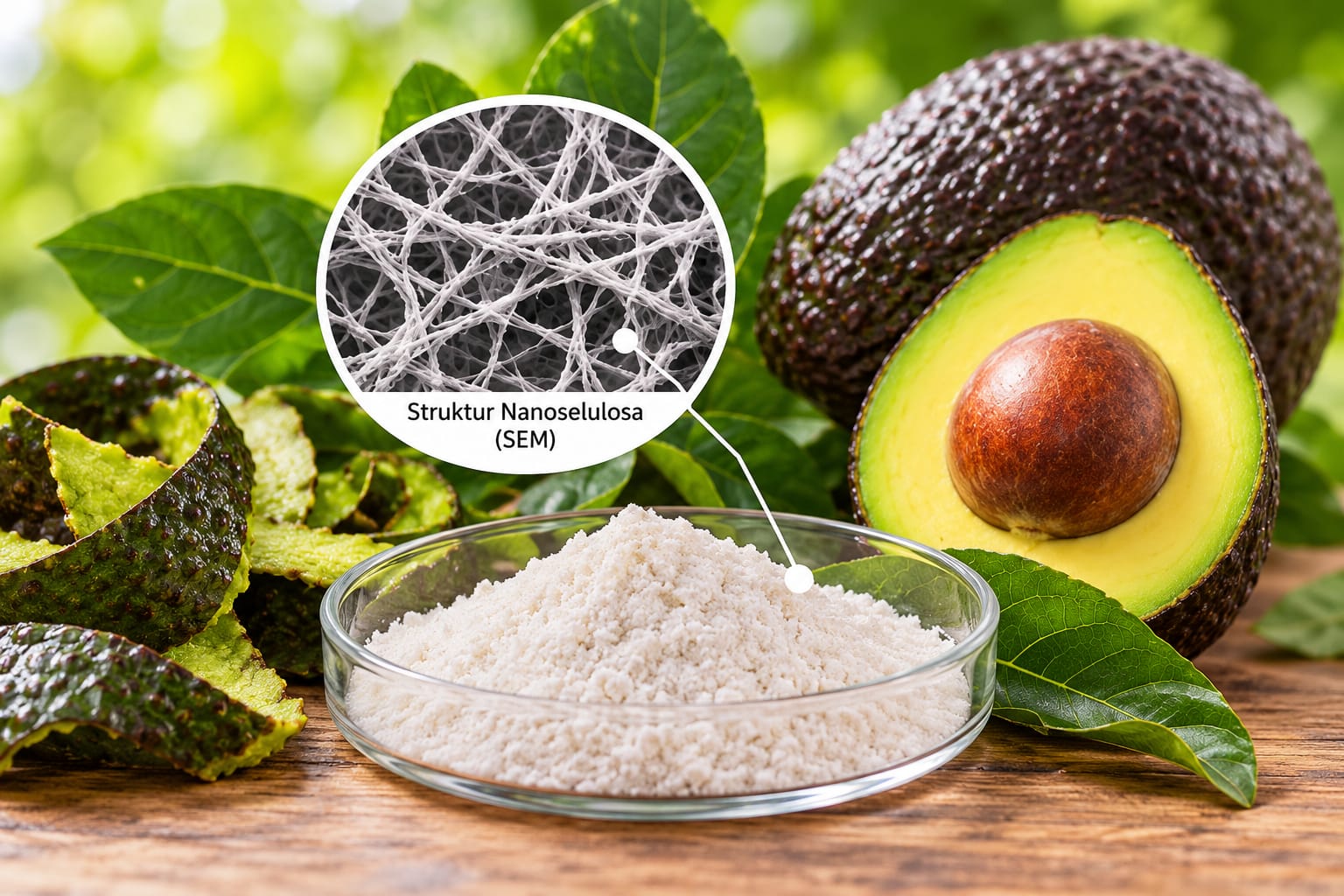
Through the process of separation and processing of cellulose fibers, an avocado skin previously considered waste can be transformed into functional raw materials with much higher value.
Science research has shown that avocado skin can be used to producecellulose nanofibers, with the potential applications in the packing industry, cosmetic, biomedical, electronic, and composite materials.
It's an opportunity raised by an avocado-based nanocellulose innovation:turning food residue into a material source for future technology and industry needs.
Opportunity for Advanced Industries
Nanocellulose Enforcement opens the possibility of various products development, especially biomaterial-based packaging, composite material amplifier, functional payers, and material support for certain product formulation.
In the packing industry, for example, the nanopelastic potentially increases the mechanical characteristics of the biomaterial based in biology. In the development of composite materials, nanopellulose can be used as a light amplifier component.
However, industrial applications still require quality testing, security, stability, production costs, and material compatibility with user needs.
Building Value from Local Resources
With an avocado production that goes beyond a million tons a year, Indonesia has a chance to develop a biomaterial supply chain based on farm and food processing.
An avocado collection of markets, liquor industry, restaurants, and fruit-proofing could be the starting point of forming new value chains that connect food companies, waste management, researchers and material industries.
This approach reflects the principle of a circular economy: expand resource value, reduce residue, and create economic opportunities through technological innovation.
The development of nano-cellulose skin suggests that the future of the sustainable industry depends not only on the discovery of new materials, but also on the ability to see the new potential of available resources.
From the bark of the removed fruit, the opportunity is born creating high-value materials. This is the essence of innovation: turning something that's considered worthless into a solution to the future.