


Imagine an electric vehicle that can determine its position, interpret its surroundings, choose a safe route, and travel to its destination without depending entirely on a human driver. What once sounded like a distant future is being tested in real-world settings at Institut Teknologi Bandung (ITB).
The work is led by ITB’s autonomous-vehicle research team under Augie Widyotriatmo, S.T., M.T., Ph.D.. The team is not only pursuing technological performance; it is also asking how technology can make mobility easier and more inclusive for everyone.
This question is particularly important in Indonesia. For persons with disabilities and many older people, trips to workplaces, health facilities, campuses, and public spaces can be difficult when transport options are not fully accessible. Autonomous vehicles offer a new opportunity to address this challenge.
Vehicles That Learn Their Environment
Enabling a vehicle to move independently is more complex than adding a computer to an electric car. The vehicle must understand what is happening around it and make decisions quickly and safely. ITB’s system combines environmental perception, localization, sensor fusion, artificial intelligence, motion planning, and autonomous control.
Sensors serve as the vehicle’s “senses.” The collected data are processed to determine the vehicle’s position and interpret surrounding conditions. The system then decides how the vehicle should move, when it should reduce speed or stop, and how it should adjust its direction.
Real-world conditions are not always perfect: sensors can be disturbed, environments can change, and the vehicle may receive incomplete information. For this reason, the team is developing a digital twin and a resilient control architecture. These allow the vehicle and its operating system to be represented digitally so that development, testing, and evaluation can be carried out systematically, including under uncertainty and sensor-performance degradation.
The technology has progressed beyond laboratory prototypes. It has reached Technology Readiness Level 7, meaning that the prototype has been demonstrated in a relevant operational environment. One demonstration is an Autonomous Guided Vehicle (AGV) for logistics needs at Teluk Lamong Container Terminal, where it can perform docking with high centimeter-level accuracy.
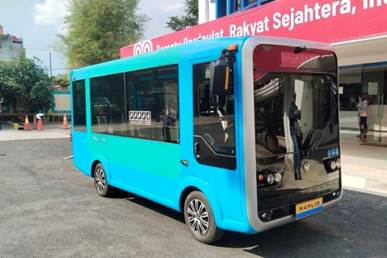
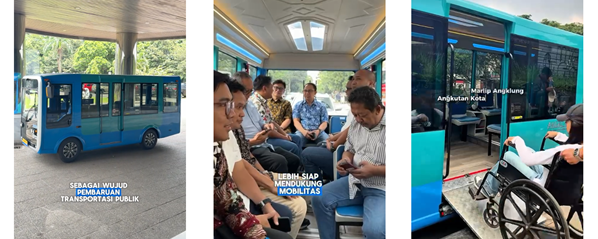
Another implementation is the ITB autonomous electric shuttle, Angklung–Bandung Electric Minibus. The shuttle serves as a real testbed for safer, lower-emission, and more accessible campus mobility, including service for passengers with disabilities.
From Inclusive Mobility to Future Logistics
The value of autonomous vehicles is not limited to sensor accuracy or stopping precision. Their success is also measured by who can benefit. In inclusive-mobility settings, autonomous vehicles can help persons with disabilities and older people gain more independent access to health services, education, employment, and social activities. At city scale, electric and autonomous vehicles can support safer, lower-carbon transport systems.
AGV deployment also opens a different commercialization path. Growing industrial areas, ports, warehousing, and modern logistics systems need vehicles that can work accurately and integrate with digital operations. The Indonesian AGV market has the potential to reach trillions of rupiah as automation develops across these sectors.
Bringing Indonesian Technology to Global Networks
ITB will continue developing and downstreaming this technology through the Science and Technology Park ecosystem, strategic industrial partnerships, and exchanges involving researchers and students from international partner universities. The team also plans to take part in a Fellowship Program and workshops with the Association for the Advancement of Assistive Technology in Europe (AAATE), as well as collaboration with AGH University of Science and Technology.
Autonomous vehicles are no longer merely research objects behind laboratory doors. The technology is beginning to operate in terminals, cross campuses, and serve passengers who have previously faced mobility barriers. Its promise lies not only in a machine’s ability to move independently, but in technology’s ability to enable more people to move independently as well.